


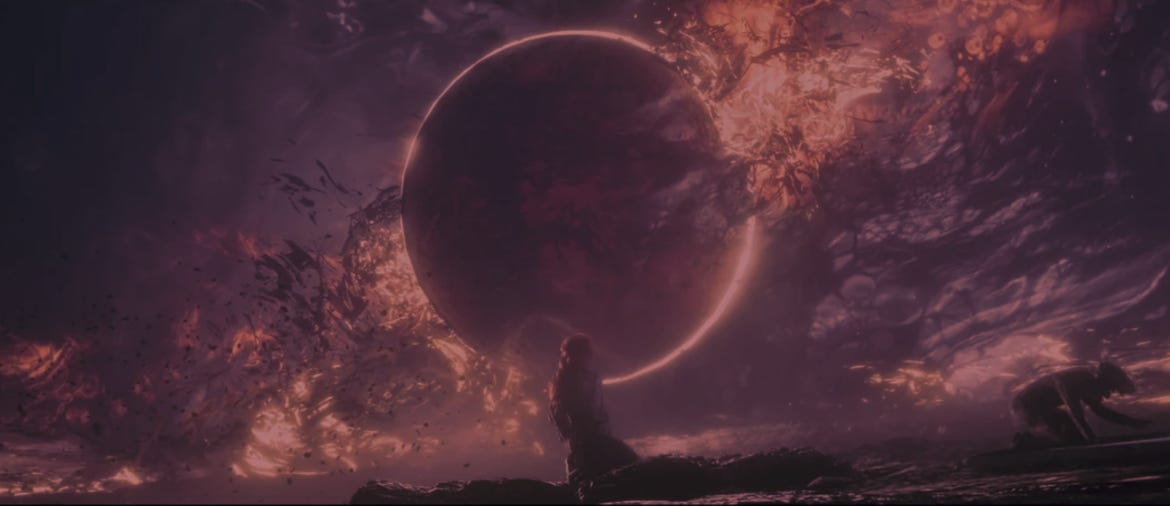
Clair Obscur: Expedition 33.Meta That Means Something
Most meta-fiction is a parlor trick.
The fourth wall breaks. The game winks at you. See? You’re playing a game. Isn’t that clever? You feel smart for noticing, the creator feels smart for pointing it out, and nothing lingers past the credits. It’s a gimmick and teaches nothing.
Clair Obscur: Expedition 33 won Game of the Year at The Game Awards, and the discourse has been predictably shallow. Gorgeous art direction. Turn-based innovation. Emotional story. All true. All missing the point.
What Expedition 33 actually does should matter to anyone who builds worlds. It constructs an entire cosmology around a question most creators never ask themselves directly:
Why do you build?
The answer the game offers isn’t comfortable. It doesn’t celebrate the creative impulse or valorize worldbuilding as noble craft. It holds a mirror up to the compulsion itself and asks whether what you’re doing is processing or hiding. Whether the worlds you build serve your life or replace it.
If you've ever surfaced from your draft at 3am unsure which world you're in as if from a dream that felt more real than the one you’re living in—this game is looking at you.
And it's asking whether you should be proud of that.
The Premise (For Those Who Haven’t Played)
Every year, the Paintress paints a number on a monolith. Everyone over that age is erased—gommaged—a word that sounds like what it does: smeared out, effaced, unmade. The count started at one hundred. Now it’s thirty-three.
Expeditions go out each year to stop her. None have returned.
This is the surface that you learn from trailers. It’s enough to make a compelling game—a ticking clock, a desperate journey, a beautiful antagonist who might be a god or a monster or both.
What struck me is that the premise didn’t sound bog-standard—I tip my hat to France—and was therefore worth a look.
But the world of Expedition 33 feels wrong in ways the premise doesn’t explain. The art direction isn’t just stylized—it’s truly painterly. The environments don’t feel like places. They feel like memories of places. The light hits surfaces the way it does in oil paintings, not photographs. Everything is slightly too beautiful.
The game knows what it’s doing. It’s showing you something about itself before it tells you.
What follows discusses late-game revelations. If you haven’t played and intend to, know this: the reveal earns the journey. Bookmark this. Come back when you have.
For everyone else—for those who’ve finished, or those who don’t mind knowing—we’re going to talk about what the game is actually about.
Worldbuilding as Diagnosis
Here’s what the game reveals: the world is a Canvas.
Literally. Lumière, the expeditions, the characters you’ve grown to love—all of it exists inside a painted reality created by a woman named Alicia. The Paintress isn’t a god or a monster. She’s a mother who lost everything and built a world to hold what remained.
The Canvas is a coping mechanism where the dead can still exist and be made real again. Where time can be controlled, where grief can be managed instead of faced directly.
This is what worldbuilders do.
We build because something in reality is intolerable. Tolkien wrote Middle-earth while carrying the trenches—the Dead Marshes, anyone? Robert E. Howard created Conan while feeling trapped in a dying Texas town, nursing a mother who would outlive his will to stay; the Hyborian Age is vitality and agency, everything Howard couldn’t access in the room where he wrote. The Brontë children built Gondal and Angria because their real world kept taking people from them, and the imaginary one couldn’t.
The Canvas isn’t metaphor here in E33.
The shape of the world you build reveals what you can’t face directly. The rules you impose expose the chaos you’re trying to master. The characters you write into existence answer (or circle) questions you can’t ask out loud.
When I build my world with its intelligent ocean that’s more god than just salt, beast-saints that dissolve the boundary between human and animal, officers who become divine at the helm: (I think) I know what I’m processing. Not trauma in the conventional sense. Something older. The vertigo of deep time. The terror of a universe that doesn’t owe me answers. The way society trains you to distrust your own intuition until you can’t hear it anymore.
My Canvas isn’t where I hide from those questions. It’s where I practice living with them. A laboratory for ontological uncertainty. A place to be frightened by mystery and learn, slowly, to stay in the room with it.
But the game asks a harder question: Is that what you’re actually doing? Or is that the story you tell yourself about why you can’t leave?
And so, Alicia built her Canvas to hold the dead.
What did you build yours to hold?
The Choice: Maelle vs. Verso
The game ends with a choice that refuses to be comfortable.
Maelle’s path: Keep the Canvas. Stay in the painted world. Your companions survive—but only as fictions. You become what your mother became. A Painter who never leaves the painting. Protected from grief by a reality that can’t hurt you because it isn’t real.
Verso’s path: Destroy the Canvas. Kill the fiction. Your friends are gone. The world you loved is gone. But you’re present in what remains—whatever that is, however much it hurts.
Neither ending is correct. And I love that this choice is here. The writers are encouraging you to have a relationship with this question without telling you what you should do. The game won’t let you have that escape of having the decision made for you.
What it will let you see is what your choice reveals about you.
There’s a difference between people who consume fiction and people who create it. Both escape but that’s not the distinction. The distinction is what happens inside the escape. Consumers inhabit. Creators build. Consumers are sustained by the world; creators are drained by it, and build anyway, pulling from some deeper well of will that the act of creation itself depletes.
Maelle’s ending is the consumer’s mercy: stay in the world, keep the characters alive, never face the loss that made the Canvas necessary. Verso’s ending is the creator’s terror: destroy what you made, lose the people who only existed because you imagined them, stand in the ashes and call it freedom.
Alicia was a creator. She built the Canvas from grief and skill and the refusal to let go. But then she stayed. She crossed from Painter to painted.
I’ve watched dozens of players make this choice. Streamers, friends, strangers in comment sections arguing about which ending is “true.” The split isn’t random. Something in how people relate to fiction—to escape, to creation, to what loss asks of them—determines which ending feels like mercy and which feels like murder.
The game doesn’t judge. It just asks you to notice which one you reached for, and why.
Painters and Writers
The game hints at a war.
Not just between characters—between types of creators. Painters and Writers. Two factions who build differently, want differently, and might be fundamentally incompatible.
Painters make worlds with image. They create spaces. Environments. Places you can walk through, inhabit, lose yourself inside. The Canvas is their medium—reality as composition, existence as aesthetic experience. Alicia is a Painter.
Writers make worlds with words. They impose narrative. Structure. Trajectory. They decide what happens, when, and why. A Writer doesn’t build a space to inhabit so much as they build a path to follow.
The game never fully explains who the Writers are. But the implication is unsettling: they might be the developers themselves. The ones who created the “real” world outside Alicia’s Canvas. The ones who wrote her.
Which means even Painters are trapped inside someone else’s story. It’s all a bit meta. I love a good meta-plot.
If you’re a worldbuilder, you know this tension from the inside. Setting-first versus story-first. Sandbox versus railroad. The compulsion to build outward—more lore, more history, more depth to your iceberg, versus the discipline to build forward, toward an ending that justifies the journey.
Painters want you to stay. Writers want you to move.
The Painter builds a world so complete you never have to leave. The Writer builds a world that ends—that reaches conclusion, that closes, that forces you back into reality with something you didn’t have before.
Most creators are one or the other. The Painters fill wikis and appendices; their stories sprawl and meander because the world is the point, not the plot. The Writers finish books; their worlds feel thin because they’re scaffolding for the narrative, not structures meant to bear weight on their own.
The rare ones, with work that haunts, are somehow both. Tolkien painted Middle-earth so completely that scholars still wander its geography. But he also wrote. Imposed the trajectory of the Ring, forced the story to end, made you leave the Shire even though you wanted to stay.
The question E33 asks isn’t which mode is correct. But rather which one you default to when you’re not paying attention and what that reveals about what you’re avoiding.
Painters might be hiding from endings. Writers might be hiding from presence.
Which trap is yours?
Now, the Mirror: Why Are You Here?
The game’s cruelest move is that it doesn’t let you watch from outside.
You’re playing Expedition 33. You chose to be here. You’re inside a Canvas—a painted world built to process grief and you’re spending hours in Lumière instead of wherever else you could be. The fiction is doing something for you, or you wouldn’t have stayed.
When Maelle faces her choice, she’s facing yours.
Not metaphorically. The game makes you complicit in the question. You pressed the button. You decided whether the Canvas lives or dies. And whatever you chose, you now have to sit with why that ending felt like the right one.
Most meta-fiction breaks the fourth wall to congratulate you for noticing the trick. E33 breaks it without even making it obvious, all to make you face the question.
The hours you spend playing, building, reading in painted worlds are hours you’re not spending in the uncontrolled mess of reality. The game observes this.
For creators, the mirror cuts deeper.
The player escapes into someone else’s Canvas. The creator escapes into their own. The player can leave when the game ends. The creator built the exits. The creator knows where the walls are thin. The creator could stay forever, and no one would know—because from the outside, it just looks like working.
Alicia didn’t mean to become the Paintress. She just never found a reason to stop painting.
There’s No Clean Takeaway
I could land this essay on a craft principle. Something tidy, such as, I don’t know— “Know why you build. Make sure the Canvas serves the life outside it. Don’t become Alicia.”
But that would be rather a pointless lie.
The game doesn’t resolve. It doesn’t tell you which ending is correct, whether creation is salvation or sickness, whether the hours you spend inside your own fiction are making you stronger or hollowing you out. It shows you both possibilities and refuses to choose for you.
I’m not going to choose for you either.
What I know is this: I’ve built a world for years. I’ve written an ocean that claims what it loves, officers who touch divinity at the helm, people who turned off their capacity to feel.
I don’t know if that makes me Maelle or Verso. I don’t know if I’m building toward something or away from something. Some days it feels like I’m excavating something fantastic. Some days it feels like burial. Exhausting.
The game asks you to look. That’s all it asks.
Whether you can answer honestly is between you and your Canvas.
The best art about art doesn’t celebrate creation. That’s obvious. Making it is the point.
Expedition 33 asks why we build worlds and whether we’re strong enough to leave them.
I don’t know yet.
Fair winds,
D. S. Black