


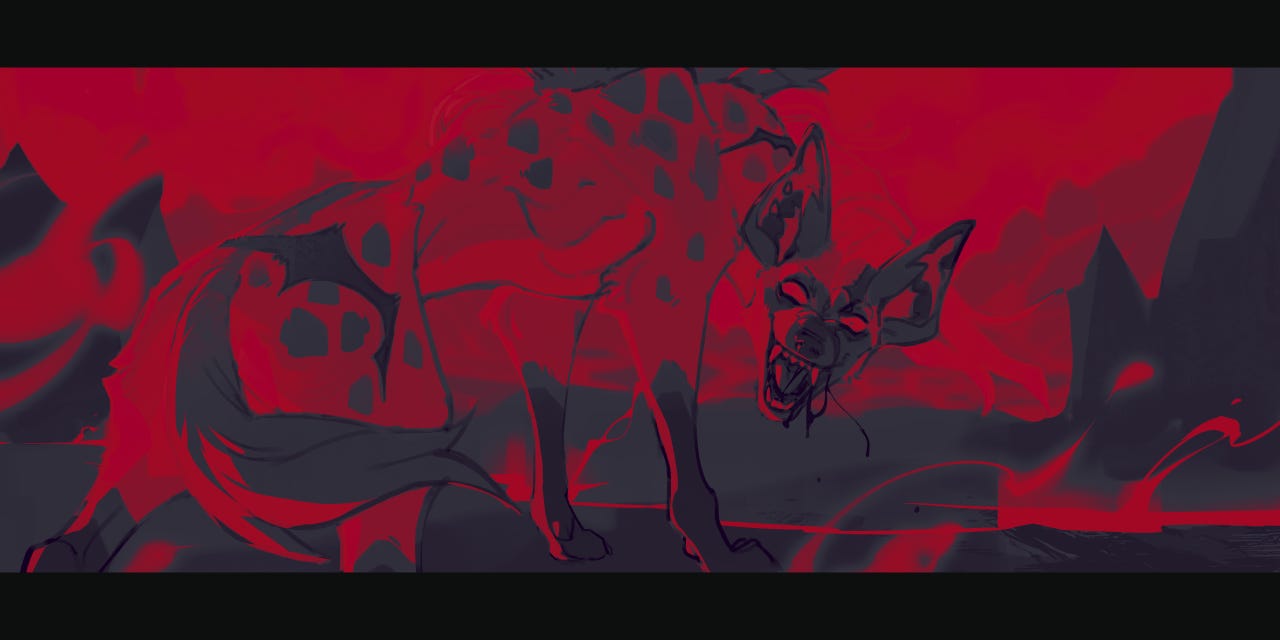
It’s popular. It circles the drain of overdone.
Jekyll and Hyde. Werewolves. The gentleman who becomes a monster when provoked. The seventeen year old’s deviantArt character with heterochromia.
We’ve been telling this story for centuries. Let’s think about why it’s so fascinating.
I posit: the transformation isn’t the point. The containment is.
Dual-nature characters aren’t compelling because they transform. Althought, for some, I suspect that is absolutely the main draw because it can be all spectacle on television. However, I believe they’re compelling because they contain both states simultaneously—and the tension of that containment is what creates character magnetism.
Somerset—if you permit me my own creation a spot—in his turquoise dress whites, speaking in measured slightly-aristocratic tones, knowing he contains something feral that the sea recognises. Conan the barbarian who understands statecraft better than the kings he deposes. The surgeon whose hands know violence and healing with equal intimacy. The hyena king whose gutter philosophy cuts deeper than any lion’s court rhetoric.
This is one of those “aesthetic obsessions” I never shut up about. Not the cliché split personality, but the more sophisticated construction: characters who are wholly and authentically both things at once. The officer who is also the beast. The scavenger who is the philosopher. The barbarian who is also the statesman.
The Transformation Trap
Most writers treat dual nature as a binary switch. Calm state. Trigger event. Beast mode. Return to calm.
Bruce Banner gets angry, becomes Hulk, smashes things, reverts. The werewolf transforms at the full moon, loses control, wakes up confused. The berserker enters rage, blacks out, surveys the carnage afterward.
I wouldn’t say this model is wrong, per se. I would say it’s a bit flatter than it could be.
It’s circumstantial. The character “becomes” a beast when angry, scared, or lunar-aligned. The duality is something that happens to them, not something they are.
It removes agency. The beast “takes over.” The civilised self is a passenger, not pilot. This is less interesting because the character isn’t choosing anything—they’re being hijacked, in a way..
It’s predictable. Readers know the trigger. They know the result. The tension becomes mechanical: will he get angry? Yes. Will he transform? Oh, yeah. Will he feel bad afterward? Of course.
The best versions of these characters, such as Hulk in recent portrayals where Banner and Hulk negotiate, integrate, coexist, have moved toward what actually works: simultaneous containment rather than sequential transformation.
The switch isn’t the story. The cage is.
Simultaneous Containment
And here is where I reframe the apparatus:
The sophisticated dual-nature character doesn’t become the beast when provoked. They are always both, and they choose which face to show.
The civilised exteriour doesn’t so much suppress the primal as it silhouettes it when it emerges. It displays through contrast.
Think about what a uniform actually does. Naval dress whites, aristocratic protocol, the measured cadence of command voice—these aren’t hiding the predator underneath. They’re framing it. The cage makes the beast legible. Without the bars, you can’t see what’s pacing inside.
In my manuscript there’s a moment where Captain Somerset takes the wheel during a storm that should kill everyone aboard. Here’s what his first lieutenant sees:
His eyes were wide with focus. His shoulders strained against the fine turquoise wool of his uniform coat, the elegant white countershading along the inner sleeves and flanks were a blinding flash against the bruised and black sky. He looked like a predator. He looked like prey. He looked like a man the sea had already claimed but who refused to acknowledge it.
Predator and prey. Officer and beast. In the same sentence. The uniform doesn’t hide what he is—the straining wool, the countershading designed to echo sacred dolphins, the formal dress barely containing something feral. It reveals it through the tension.
This is the principle: not transformation, but containment. Not “he becomes dangerous when pushed” but “he is always dangerous, and what you’re seeing right now is how he holds it.”
Three Expressions: Somerset, Gore, and Daud
The dual nature doesn’t have one shape. In my cast, three characters demonstrate three different expressions of the same principle.
Somerset’s charm is a lie. His rakish (oh, I love that word) persona coalesced in a moment of humiliation. And that moment created the persona: seductive, dangerous, magnetic. All to contain something his culture really doesn’t want to put a name on.
The sea recognises what’s underneath. In his world, the sea is the ultimate predator. Sentient, predatory and starving. To be seen by the hungry ocean is to have your capacity for violence recognised and to therefore open a connection to it. To read it and be welcomed in to drown. Or to keep you and your ship out of reach and stay afloat through listening to the song it sings.
But to speak that language of the sea—the one of something vast and hungry—you need be be just like it.
The gentleman is real. The beast is real. The tension between them is what makes him a witch-captain.

Then there’s Lieutenant Gore. His dual nature inverts the expectation. Where Somerset’s beast is passion barely contained, Gore’s is coldness.
When a Navigator goes missing—slipped overboard and lost—Gore delivers the news:
He said it as if he were explaining a mechanical failure. A component that had exceeded its tolerances and failed. Unfortunate, but predictable.
“Already done, sir.” He tapped the ledger under his arm.
Death logged, filed, processed. His beast—the mirror-image to his containement—is the reptilian efficiency that can catalog a soul and move to the next task without so much as pause.
His aristocratic rulebook, his obsessive adherence to regulation, his ice-cold social formality—these aren’t suppressing his emotions. They’re the shape his predation takes. The civilisation is the weapon.
Some readers expect “cold” characters to secretly have warmth underneath. Gore doesn’t. His inability to feel warmth isn’t a flaw to overcome. Short of making him interesting on the page, it’s the feature that makes him devastating. It’s the point.
So, Daud van Richter, the operative who becomes Somerset’s unlikely mirror—And I keep telling you, I swear it’s not a romance—demonstrates a third variation: beast as profession.
Daud’s knife found the space between the fourth and fifth rib. It was not a dramatic thrust. It was not even particularly violent a motion.
And afterward. No catharsis:
He washed his hands, watching the faint pink swirl away (…) adjusted his coat, smoothing the severe lines of the Befruoren cut.
Mind already on the next variable. The containment continues after violence. That’s the beast as profession.
No berserker rage. No loss of control. No transformation. Daud is a killer the way a surgeon is a surgeon. Whether by training, practice, or craftsmanship. His “civilised” presentation (the elegant fingers, the measured voice, the patience) isn’t containing something wild. It’s containing something merely professional.
The principle across all three, if I’m to sound like I know anything about what I’m talking about and not merely winging this: the “primal” doesn’t have to mean rage. Somerset’s beast is passion. Gore’s beast is precision. Daud’s beast is professional competence at killing. The containment is what matters, not the specific shape of what’s contained.
What matters is that there are two things simultaneously true about one character that, when pulled apart, seem incompatible.
The Inversion Principle: Conan and Chaa
The dual nature works in either direction. The interesting characters aren’t always officers containing beasts. Sometimes they’re beasts containing officers.
Robert E. Howard’s Conan—whom I adore to pieces—isn’t compelling because he’s a barbarian. He’s compelling because he understands statecraft, reads political situations with a general’s eye, and recognizes civilisation for what it is—Which is organized savagery with etiquette. And through his ability to inhabit both worlds, is able to offer precise observations that make you consider about how absurd it all is.
“Barbarism is the natural state of mankind. Civilisation is unnatural. It is the whim of circumstance. And barbarism must ultimately triumph.”
The primal exteriour contains strategic intelligence. Conan survives throne rooms and battlefields because he operates in both of these registers. The barbarian contains the king.
One more. Chaa, my hyena king from Clawstar—a different project, genre but same bones—takes that further. Chaa is a literal scavenger. He’s a second-tier male in a matriarchal clan, destined for subservience and scraps. When the lions’ “righteous cull” murdered his queens, his sisters, his matriarchs, he filled the power vacuum not with nobility or tradition but with teeth and cynical clarity.
“Their law is the cage, and they are surprised when the prisoners rattle the bars. Let the dark come. At least it is honest.”
Cynical wisdom forged in the gutter from of the mouth of a low-life. The prides who cull his kind believe they’re civilised. Chaa understands that their civilisation is just violence with cleaner aesthetics.
To his followers, Chaa is the necessary monster. To his enemies, he is the embodiment of chaos—never realizing they were the ones who created him.
Chaa isn’t like Conan because he is not romantic. No nobility in his savagery. He’s a king of scraps whose worldview was proven correct by the very powers who look down on him. His wisdom isn’t despite his circumstances. He’s not rising above anything. And his low vantage allows him to see what the apex predator cannot.
Building Dual Nature from the Ground Up
How to do it?
Make it more than circumstantial.
Don’t give them a trigger. Build the duality into their baseline psychology. The question isn’t “when do they become dangerous” but “what keeps them from being dangerous all of the time.”
The cage is visible. Right there.
Uniform. Protocol. Ritual. Manners. Code. Whatever your character uses to structure themselves—it shouldn’t hide the beast. It’s framing the beast. Readers need to see the cage and what’s pacing inside.
Then, let the civilised and primal serve different functions.
The officer makes you effective. Things like strategy, command, social navigation, long-term thinking. The beast makes you dangerous. Survival, violence, instinct, immediate action. Both necessary. Neither is “the real them.”
No “normal mode” versus “beast mode.” The character should be readable as both in every scene. Readers should always be slightly uncertain which face they’re seeing, because both faces are always present. The charm that might be genuine or might be calculation. Keep both possibilities alive.
Make the containment costly.
The cage takes energy to maintain. Protocol is often exhausting. Performance is labour. Let readers see what it costs to hold the beast—whether by drinking, isolation, relationships that can’t survive proximity to something that controlled. The containment shouldn’t always be effortless. It should be the character’s primary ongoing work.
Why This Works in Grimdark
This concept, I believe, has a special place in the thematic throughline of grimdark. Which is why I wanted to mention this on its own.
Grimdark demands characters who can survive horror without breaking. Cozy fiction can have protagonists who are purely civilised because their worlds don’t require predation. Grimdark worlds do.
The mathematics are simple:
Pure civilisation breaks under pressure. It can’t do what survival requires. When violence is necessary, the purely civilised character hesitates, compromises, or shatters.
Pure beast can’t navigate complexity. No strategy, patience, or social intelligence. Raw predation without containment burns out fast—killed by something smarter, betrayed by a need for patience.
Both simultaneously? Devastating.
And the tension between two natures that seem—on the surface—diametrically opposed, is what makes a character unforgettable.
If this resonated, you might also want to read the companion piece on why compelling beats likeable every time:

For more craft analysis, character breakdowns, and worldbuilding deep-dives, subscribe.
Fair winds,
—D.S.