


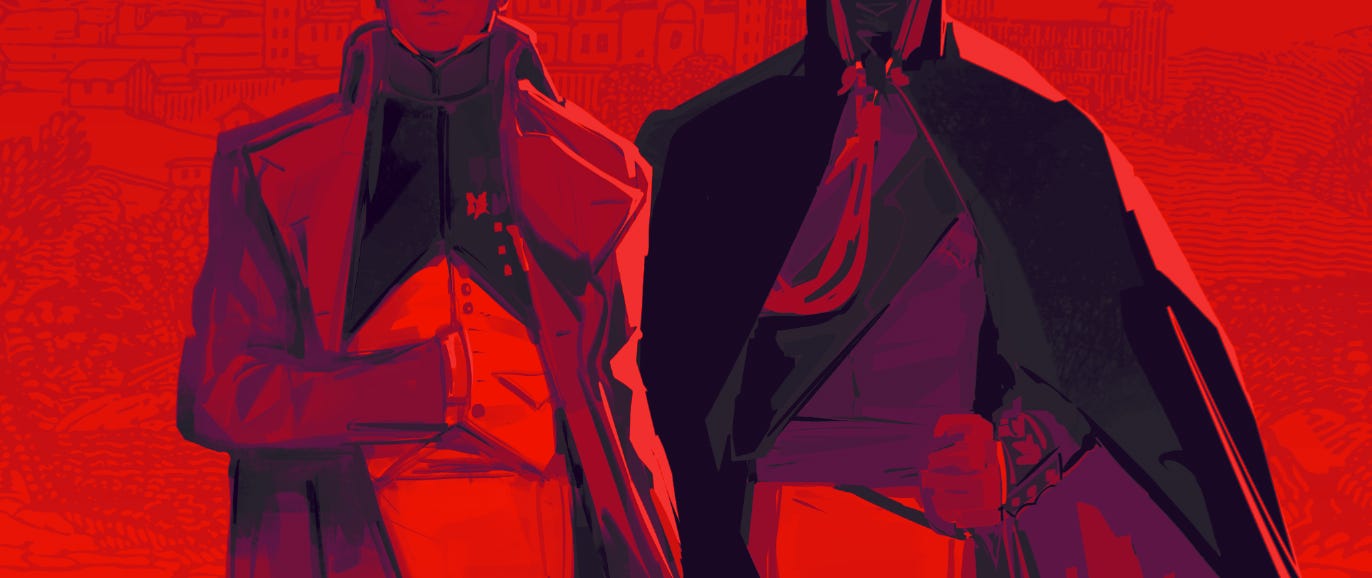
The Homosexual Was Invented in 1869.
Not same-sex desire—that’s as old as humanity. Not same-sex acts—every legal code in history that bothered to criminalise sodomy proves people were doing it. What was invented in 1869 was the homosexual as a type of person. A “species”, a diagnosable condition, and with a characteristic psychology, recognisable traits.
Before that, there were things people did. After that, there were things people were.
If you’re writing historical fiction set before the late nineteenth century and your characters are navigating sexual identity—e.g. questioning what they are, coming to terms with themselves, finding their community—you’re writing ahistorical fiction. You’ve given your characters a framework for self-understanding that hadn’t been invented yet. This is like giving them germ theory or the unconscious mind: a conceptual tool they simply didn’t have access to.
This matters for the craft of the story, not merely accuracy. Because the stories available to people without identity categories are different stories than coming-out narratives. And most of them aren’t being written.
Act, Not Identity
The distinction is simple but its implications are total: before the late nineteenth century, there were sexual acts, not sexual persons.
Sodomy was a sin. Buggery was a crime. These were things you did, like theft or blasphemy, not things you were. A man who committed sodomy was a sodomite in the same way a man who committed murder was a murderer: the noun described the act rather than an ontological category.
This means there was no “closet” to be in. No identity to suppress or discover. No authentic self being hidden beneath a performed self. I will talk about that a few sections deeper in.
The Symposium
To understand what you’re missing, go back to Athens. Around 385 BCE. To a drinking party where some of the most influential thinkers in Western history are arguing about the nature of love.
Plato’s Symposium is structured as exactly that—a symposion, which is a ritualised evening of wine and conversation among educated men. The premise is simple: each guest will give a speech praising Eros, the god of love. What emerges is a philosophical framework for understanding desire which has dominated Western thought for centuries and that most modern writers have never encountered.
It starts with Pausanias, who takes a position that there are two Aphrodites, and therefore two kinds of love.
Common Aphrodite (Pandemos) : The love directed at bodies. It’s indiscriminate, base, focused on physical gratification. It’s the love men feel for women, concerned primarily with reproduction and the satisfaction of appetite. It fades when beauty fades.
Heavenly Aphrodite (Ourania) : Born from Ouranos alone, no mother, no female element. This love is directed at souls. It seeks wisdom, virtue, the genuine good of the beloved. It endures. And it exists, Pausanias argues, only between men.
The philosophical position isn’t that male-male love is tolerable but that male-male love is higher and spiritually superior to heterosexual desire, which is argued as being mired in the bodily and temporary.
Getting into the many ways this might be interpreted is beyond scope, so let’s move on.
To Aristophanes, a comedian and satirist; he offers a myth so striking it still echoes in modern language, although we’ve forgotten where it came from.
Once, he says, humans were double creatures. Four arms, four legs, two faces. There were three sexes: male-male, female-female, and male-female. These beings were powerful, threatening the gods themselves, so Zeus split them in half. Ever since, we’ve wandered the earth searching for our other half, longing to be whole again.
You’ve heard this. “My other half.” “My soulmate.” You’ve probably assumed it was always about heterosexual romance.
It isn’t. In the original myth, men descended from the double-male seek other men. Women descended from the double-female seek other women. Only those from the androgyne seek the opposite sex. All three: equally natural, equally cosmic, equally the soul trying to remember itself.
One could spend years with the implications. These were men with no feeds to scroll, no content to consume. They sat with questions. They examined their interoceptive experience, their felt sense of love, longing, recognition, with a rigour we've largely abandoned. Maybe Aristophanes meant the myth literally. Maybe it's allegory. Or maybe it was the only way he could reach toward whatever unknowable process defines us, and who—or what—we were before we were born.
Finally, Socrates speaks. But he doesn’t offer his own theory—he recounts what he learned from a woman named Diotima, a priestess who taught him the mysteries of love.
Her teaching is that love is a ladder. And you climb it through desire.
You begin with the love of one beautiful body. A specific person, a specific form that stirs you. But if you’re paying attention—thinking—you start to notice that the beauty in this body resembles the beauty in other bodies. You’re not just attracted to him. You’re attracted to something in him that exists elsewhere too.
So you ascend. From one body to the recognition of beauty in all bodies. From physical beauty to the beauty of souls, of minds, of character. From beautiful minds to beautiful practices and laws. From human beauty to beauty in knowledge itself. And finally at the top of the ladder—to the Form of Beauty. Pure, eternal, unchanging. The thing itself, of which every beautiful person or idea is merely a shadow.
Eros is the engine of philosophy. Desire is what moves you up the ladder. And where does it start? With a man’s love for a beautiful youth.
Their words, not mine.
Arriving Backwards
I should tell you how I found the Symposium.
Not through any structured curriculum—well, nothing I find is through any structured means. I found it because I was trying to understand myself, and the modern labels weren’t working.
I wasn’t attracted to solely bodies or genders. I was attracted to traits. Agency. Ambition. A mind that moved in ways I found beautiful. These traits manifest differently in different people, and the erotic and intellectual weren’t separate channels but the same current moving through different terrain.
There’s no checkbox for this.
So I started researching. Roman sexuality first—I write naval fiction set in that world’s very long shadow, and I needed to understand how my characters would think. That led me backward to what the Romans had inherited. To the Greeks. To a drinking party in 385 BCE where men were describing something I’d arrived at by accident, alone, two and a half thousand years later.
That felt indicative. If anything, it felt like relief.
If you give yourself permission to truly examine your experience and not immediately reach for a label and rely on category someone else made, just sit with it—you might find the Greek framework more resonant than the medicalised one.
Roman Pragmatism—Status, not Orientation
Rome inherited Greek philosophy but didn’t swallow it whole. The Romans were engineers, legislators, empire-builders. They took what was useful and discarded what felt too soft, too abstract, too Greek.
What they kept was practical. And what they built was a system organised entirely around power.
Romans had no word for homosexuality because they didn’t think in those terms. What they cared about was penetration—who was doing it, and to whom. The axis of this wasn’t gender. It was status.
A Roman citizen—a vir—could penetrate essentially anyone of lower standing without moral consequence. Slaves of any sex. Prostitutes. Foreigners. Actors, gladiators, anyone whose legal status was already—to the Roman social hierarchy—degraded. The act itself carried no stigma. What mattered was whether you were using or being used.
The anxiety ran in one direction: down. A citizen who allowed himself to be penetrated had degraded himself to the status of a slave or a woman. He’d abandoned the self-mastery that Roman masculinity required. He’d made himself pathicus—passive, receptive, suspect in all areas of life. Not because he desired men, but because he’d accepted a subordinate position unbefitting his station.
This is a completely different psychological landscape. A Roman general could take a male slave to his bed for decades and no one would blink. That same general, rumoured to have submitted to another man, could lose his career, his reputation, his standing in the Senate. The crime was hierarchy violation, not “homosexuality”—which, I'll remind anyone who hasn't heard it, they had no word for.
But Rome was never just Rome. The educated classes read Greek, were tutored by Greek slaves, thought in Greek when they philosophised. They had access to the Symposium. To Plato. To an entire tradition that offered a different frame.
This meant a Roman could code-switch. He could be Roman in the Forum—concerned with status, hierarchy, the appearance of dominance—and Greek in his private hours, understanding his attachments through a lens that ennobled rather than degraded.
Consider Mark Antony. Cicero accused him of having been Curio’s catamite in his youth—a political attack, weaponising the shame of the passive role. But what Cicero described, stripped of its rhetoric, was something else: Antony sneaking into Curio’s house at night. A young man, besotted, taking risks to be with someone. That’s a particular friendship, navigated in secret, between equals.
How did Antony understand it? We can’t know. But he had Plato on his shelf. He had a framework that said this love was higher, not shameful. He could hold Cicero’s contempt in one hand and the Symposium in the other, and decide for himself which lens fit his experience.
The Roman who loved another man wasn’t without resources. He just had to sometimes reach for them quietly.
Georgian England—Christianity, Capital Crime, and the Gentleman’s Agreement
We arrive at this period most writers think they understand. The age of sodomy laws. The hangings. The Church’s long shadow.
They’re not wrong that it was dangerous. They’re wrong about almost everything else.
Sodomy was a capital crime in England from 1533 until 1861. Men were hanged for it into the 1830s—more men executed for sodomy than for murder in some years during the Napoleonic Wars. The law was brutal, and it was real.
But it wasn’t universal.
Across the Channel, France decriminalised sodomy in 1791. The Revolution swept away the old religious laws. Napoleon’s Penal Code of 1810 maintained the change—what consenting adults did in private simply wasn’t the state’s concern. So while English sailors faced the gallows, French officers faced... nothing. Same acts. Same desires. Same continent. Different jurisdictions, different outcomes.
This should demolish any notion that “this is just how people thought back then.” There was no unified pre-modern attitude. There was politics, religion, legal tradition, and local enforcement—a patchwork that varied by nation, by class, by decade, by sheer luck. Your Georgian characters lived in a world where crossing the Channel could mean the difference between death and indifference. That’s not a monolith. That’s a landscape to be navigated.
And even within England, law and life were not the same thing.
Conviction required proof of penetration. This means witnesses. Evidence almost impossible to produce without a confession or someone caught in the act. Most prosecutions were for “attempted sodomy” or “gross indecency.” Serious, but not the gallows. And even this required someone to talk.
This created a system where discretion was everything. Not secrecy, per se. Not really the closet (which we’re defining as a hidden authentic self buried beneath performance.) Discretion. Conduct. The management of what was seen and what was said.
The gentleman’s agreement was simple: don’t make us know.
Class mattered enormously.
Aristocrats and gentlemen had resources the law couldn’t easily touch. Private spaces. Servants whose livelihoods depended on silence. Social networks that closed ranks against scandal. The assumption of respectability that made accusations seem implausible, even vulgar to voice.
Working-class men had none of this. The molly houses—gathering places with their own culture, their own argot, their own rituals—were periodically raided. Men caught in public spaces, in parks, in alleyways, had no shield. The law fell heaviest on those with the least protection, as law tends to do.
But among gentlemen? Two men could be inseparable. Could live together. Could be understood by everyone around them to have a “particular friendship.” As long as no one said the unspeakable, it remained within the bounds of acceptable conduct. They weren’t hiding. They were navigating.
What modern writers miss most often: these men could be Christian. Genuinely, devoutly Christian. Without constant internal warfare.
There was no identity to reconcile with this.
A Georgian naval officer who loved his lieutenant wasn’t “a gay man who is also Christian.” He was a Christian gentleman, devoted to his duty and his God, who also had a particular friendship he conducted with appropriate discretion. The things he did and felt didn’t constitute a category of person that stood in opposition to his faith. There was no “homosexual Christian” contradiction because there was no homosexual. Just a man. Living his life. Managing his conduct. Loving who he loved.
The drama of the closet—the suffocating sense of living a lie, of being divided against yourself—requires identity categories to function. Without them, you have danger, yes. You have discretion. You have real consequences if you’re careless or unlucky. But you don’t have the modern psychological architecture of repression, of the authentic self imprisoned beneath the performed self.
That’s a different kind of story. Harder to write, maybe, because we’re so accustomed to the other one. But truer to the period.
The Shape of the Cage You Can’t See
Here’s where you do some work. Because if you’re a modern reader, what I’ve just described probably sounds like repression. Like these men were “in the closet.” Like they were hiding their true selves behind a performance of respectability.
They weren’t. And the reason you think they were is because you can’t see the shape of your own cage.
Let me try an exercise.
You eat meat. Maybe you don’t—but assume for a moment you do. You’ve eaten thousands of animals over your lifetime. You probably don’t think about it much. You don’t consider yourself “a carnivore” in any meaningful identity sense. You don’t belong to the meat-eating community. You don’t feel that your burger consumption needs to be reconciled with your other values, nor do you expect the approval of other meat-eaters, nor do you structure your social life around access to fellow carnivores.
You just... eat meat sometimes. It’s a thing you do. Not a thing you are.
Now imagine a future where this changes. Where industrial farming becomes so morally indefensible that society ruptures over it. Where eating meat becomes a political identity—where you’re either a Carnivore or a Vegan and you’d better pick a side. Where scientists start classifying people by their “dietary orientation.” Where children are asked to discover and declare their authentic food-selves. Where you could come out as a carnivore to your vegan parents, or struggle to reconcile your carnivore identity with your environmentalist values.
Sounds exhausting, right? Sounds like it would take something simple and make it unbearably complicated?
That’s what happened to sexuality. And you’re living in the aftermath.
And if that didn’t land, try this.
Think of something you experience that you don’t have a word for.
Maybe it’s that specific melancholy that hits on Sunday evenings. Maybe it’s the discomfort of hearing your own voice recorded. Maybe it’s the strange guilt of being happy when someone close to you is struggling. You feel these things. They’re real. But you don’t identify as them. You don’t structure your social life around finding others who share them. You don’t come out to your parents as Someone Who Feels Weird On Sunday Evenings.
You couldn’t, even if you wanted to. The category doesn’t exist. There’s no community to join, no flag to fly, no identity to claim. The feeling is real; the framework isn’t.
Now imagine that’s your entire experience of desire.
You love who you love. You want who you want. It’s as real and consuming as anything you’ve ever felt. But when you reach for the shelf where the labels should be, there’s nothing there. No “gay.” No “bisexual.” No “homosexual.” Not even “heterosexual”—that word was invented after homosexual, to describe the people who weren’t the new medical category.
You don’t think “I’m attracted to men, so I must be...” because there’s no end to that sentence. You just are. Attracted. To him. Right now. The question of what this makes you doesn’t arise, because it’s not a question anyone has learned to ask yet.
That’s not repression. That’s not denial. That’s a mind working without tools we take for granted—and maybe, in some ways, working more freely because of it.
The Georgian officer who loved his lieutenant did not have a closet to be in.
The closet requires an inside and an outside. It requires an authentic self—the real you—hidden behind a performed self. It requires the concept of “living a lie,” which requires the concept of a singular truth about what you are that you’re betraying.
None of this architecture existed.
He wasn’t hiding his True Gay Self behind a performance of heterosexuality. He was a man. He had desires, some of which were dangerous to act on. He had a close friendship, the precise nature of which was nobody’s business. If he was careful, he’d never face consequences. If he was careless, he might face the law—but the law would be punishing his actions, not his identity. He’d be a gentleman who committed a crime. Not a homosexual revealed.
The shame, if he felt it, attached to conduct. To risk. To the possibility of exposure. Not to being fundamentally wrong. You cannot be ashamed of what you are if “what you are” isn’t a category anyone has invented yet.
I must keep insisting the stories available to these men were different. The drama isn’t “who am I?” It’s “how do I live?” Rather than a self-discovery, it’s having discretion. Love finding its way through a landscape of danger—not a soul at war with itself.
1869—The Invention of the Homosexual
Everything I’ve described ended in a doctor’s office in Germany.
The word “homosexual” was coined in 1869 by Karl-Maria Kertbeny, a Hungarian journalist arguing for the decriminalisation of sodomy in Prussia. His intent was progressive. His logic was simple: if same-sex attraction was an inborn condition rather than a moral failing, then punishment was as senseless as imprisoning someone for being left-handed.
He wasn’t alone. The sexologists who followed—Richard von Krafft-Ebing, Havelock Ellis, Magnus Hirschfeld—built taxonomies. They catalogued case studies. They identified symptoms, proposed causes, described developmental histories. They were trying to help. Krafft-Ebing’s Psychopathia Sexualis (1886) reads as clinical and detached now, but its project was fundamentally sympathetic: reclassify sodomy from sin to sickness, and you remove the justification for the gallows.
It worked. Slowly, unevenly, but it worked. The medical framework gave reformers a lever. You cannot punish pathology. You can only treat it—or, eventually, accept it.
But something else happened. Something the reformers didn’t intend.
Michel Foucault put it most precisely: “The sodomite had been a temporary aberration; the homosexual was now a species.”
Before 1869, there were acts. After 1869, there were people. A new category of human being, defined by their desire, knowable through their characteristics, diagnosable by their presentation. Not a man who committed sodomy, but a homosexual—a type, with a psychology, a developmental arc, an essence.
The identity was born. And it could never be put back in the box.
The Oscar Wilde trials of 1895 crystallised it for the English-speaking world.
Wilde wasn’t just prosecuted—he was typified. The press coverage constructed an image: the aesthetic, the effeminate wit, the green carnation, the French novels, the dandyism that now meant something specific. Suddenly there was a recognisable figure. A stereotype. A way to identify them.
This cut both ways.
For the hostile, it provided a target. The “Oscar Wilde type” became a thing to suspect, to police, to exclude. Effeminacy that had been merely unfashionable became evidence. The vague became legible.
But for men who desired men, it provided something too: recognition. If there was a type, you could find each other. You could know you weren’t alone. The very category that enabled persecution also enabled community. Subcultures could form around shared identity. You could belong to something.
There’s a bargain of identity. It makes you visible—to your enemies and your allies alike.
The Cure for the Disease They Invented
The dark irony of medicalisation: if homosexuality is a condition, conditions can be treated.
The doctors who pathologised same-sex desire weren’t trying to create a new form of torture. They were trying to save men from the gallows. But once you’ve established that the homosexual is a clinical entity, a developmental aberration, a psychological malformation: the next question becomes obvious.
Can we fix it?
Conversion therapy didn’t emerge from hatred. It emerged from the medical framework itself. If homosexuality was an illness, then doctors had a duty to seek a cure. Electroshock. Aversion therapy. Hormonal intervention. Psychoanalysis aimed at resolving the “arrested development” that had produced the inversion. These weren’t conceived as punishments. They were treatments. The men who administered them often believed they were helping—relieving their patients of a condition that caused suffering and social exclusion.
The suffering, of course, was largely caused by the categorisation. But the loop was invisible to those inside it. We defined you as sick; your life is hard because you’re sick; let us try to cure you so your life will be easier.
This is what happens when you medicalise human experience. You create patients. And patients need doctors. And doctors need treatments. And treatments need to work, or at least be attempted, because that’s what medicine does.
As my grandmother would say in the most defeated tone: “ayi, ayi, ayi…”
The road from Krafft-Ebing’s sympathetic case studies to electrodes attached to men watching images of other men is a straight line. No one meant to build that road and yet—hindsight and all that.
From Subculture to Constituency
The twentieth century added new pressures.
Urbanisation concentrated people. In villages, everyone knows everyone. Deviance is visible, policed by neighbours and gossip. Cities offered anonymity. You could disappear into London, into Berlin, into New York, and find others. The molly houses of the eighteenth century had been local, fragile, periodically destroyed by raids. The urban subcultures of the twentieth century were larger, more resilient, more organised.
Where there’s a community, there’s the raw material for politics.
Stonewall, 1969. A police raid on a Greenwich Village bar met resistance instead of compliance. The riot that followed didn’t create the gay rights movement—organising that had been happening for decades—but it crystallised something. It became a symbol. A founding myth. A moment when the community fought back.
And now the identity that doctors had invented became something else: a political constituency.
This is the logic of rights movements. You cannot fight for legal protections for “men who sometimes have sex with men.” You need a defined group with shared interests, shared enemies, shared goals. You need gay people as a category to be legible, countable and therefore capable of being represented.
The categories hardened because they had to. Ambiguity is useless in a courtroom. Ambiguity doesn’t get funding. Ambiguity doesn’t win elections or change laws. You need to be able to say who is affected, how many there are, what they need. You need identity to be recognisable, defensible.
This worked. It won rights, protections, visibility that would have been unimaginable a century earlier. But it came at a cost. The cost of the categories themselves becoming mandatory. You weren’t just allowed to identify as gay. Increasingly, you were required to, if you wanted access to the community, the politics, the protections.
The Crucible—AIDS and the Politics of Survival
Then came the plague.
The AIDS crisis of the 1980s did something to gay identity that nothing else had done: it made identity survival.
Young men were dying. The government was ignoring them. Hospitals were refusing them. Families were disowning them. And the only people who showed up, organised care networks, fought for research funding, who held the dying and buried the dead were the community.
You cannot understand modern LGBT identity politics without understanding that they were forged in a crucible where belonging to the community meant someone would bring you soup when you were sick and fight for the drugs that might save your life, and not belonging meant dying alone while the president refused to say the word “AIDS.”
Identity became non-negotiable because identity was what kept you alive.
The boundaries hardened further. Resources were scarce and targeted—you needed to know who qualified. Political organising required clear constituencies. The question “are bisexuals really part of the community?” wasn’t abstract; it determined who got access to support networks, who was represented in advocacy, whose deaths were counted in the statistics used to demand government action.
This is why identity feels so existential to people who lived through that era or inherited its trauma. It was life and death. The labels were not arbitrary.
The Inheritance
So here we are.
The Greeks had philosophy that elevated same-sex love as a path to divine beauty. The Romans had pragmatism that cared about status, not orientation. The Georgians had discretion, particular friendships, and the gentleman’s agreement. None of them had identity.
Then the doctors invented a species. Then the species was tortured in the name of cure. Then the species organised, fought back, won rights, built community. Then the plague came and the community became a lifeline. Then the battles were won—not all of them, not everywhere, but enough that a new generation inherited the categories without inheriting the context.
And now we have people who cannot imagine desire without identity. Who think “people haven’t changed—there were always gay people” and don’t realise they’re projecting a framework backward onto minds that would have found it incomprehensible. Who write historical fiction where characters “discover they’re gay” in 1743, as if the discovery were possible, as if there were a thing there to discover.
The identity categories were necessary. They saved lives. They won rights. I’m not saying we should abolish them.
I’m saying they’re recent. They’re contingent. They’re one way of organising human experience, not the only way, and not the way that existed for most of history. If you want to write characters who lived before the invention of the homosexual, you need to understand that you’re writing people with different interior lives—not repressed moderns or closeted contemporaries, but rather different minds navigating a different landscape.
That’s the craft challenge. And it’s harder than it looks.
So let's talk about how to actually do it.
What This Means for Your Fiction
So. You’re writing a naval captain in 1805 who loves his lieutenant. You’re writing a Roman tribune who can’t stop thinking about his optio. You’re writing a Renaissance artist whose muse is the boy who grinds his pigments.
How do you do it without projecting?
The Question Changes
Modern queer narratives are structured around a question: Who am I?
The character discovers their desire. They struggle to reconcile it with their sense of self. They suffer, hide, perform, and eventually—in the hopeful version—come to accept themselves. The arc is interior. The drama is identity. The climax is self-acceptance.
Your historical characters don’t have this arc available to them. Not because they’re repressing it—because the question doesn’t exist.
Their question is different: How do I live?
This is not a lesser question. It’s an older one, and in some ways a harder one. It’s the question of conduct. Of navigation. Of building a life around a desire that is dangerous to act on, without the framework of identity to make that danger feel like oppression of the “true self.”
The drama is external. The stakes are material. What happens if we’re seen? What happens if he’s transferred to another ship? What happens if I’m promoted and he’s not? What do we owe each other? What do we risk for each other? How do we speak about this thing we never name?
These are not smaller stories. They’re different stories. And almost no one is writing them.
Desire Without Declaration
The challenge that results: write attraction without labelling it.
Modern characters tend to realise things. “He realised he was attracted to men.” “She finally admitted to herself that she was in love with her.” The realisation is the turning point. The internal acknowledegment precedes the external action.
Your historical characters don’t realise what they are. They want. Wanting doesn’t require a label. It requires an object.
He watches the lieutenant’s hands on the glass. He finds reasons to be in the same room. He thinks about him while falling asleep. He volunteers for the same watches. He tells himself it’s admiration, respect, the natural affection between officers who trust each other with their lives. He doesn’t tell himself he’s gay, or bisexual, or struggling with his sexuality—because none of those concepts exist.
He just wants. And wanting is enough to drive a story.
The reader will understand what’s happening. You don’t need to spell it out. Trust them to recognise desire without having a character narrate their identity crisis.
The Particular Friendship Is Not a Euphemism
Georgian England had a term: the particular friendship. Two men whose attachment was understood to be extraordinary. Who lived together, travelled together, were rarely seen apart. Whose affection exceeded the ordinary bonds of masculine camaraderie.
Modern readers see this and think: euphemism. A way of not saying what everyone knew.
But that’s not quite right. The particular friendship was a real social category—a recognised form of relationship with its own expectations and boundaries. It wasn’t a lie covering a truth. It required no further specification.
What happened behind closed doors was private. What was displayed publicly was the friendship: the loyalty, the devotion, the evident preference for each other’s company. This was legible, acceptable, even admirable. David and Jonathan. Achilles and Patroclus. The tradition was ancient and honourable.
Your characters can have this. They can speak of their particular friendship openly. They can be known for it. The silence isn’t about the relationship—it’s about the specific physical acts that the law cared about. Everything else can be in plain sight.
This gives you something the modern closet narrative doesn’t: public intimacy. Your captain and his lieutenant can be visibly devoted to each other. They can dine together every night, share quarters when possible, grieve openly if separated. None of this requires hiding. The hiding is narrower than you think—and what’s left in the open is larger than modern readers expect.
Strategic Silence vs. The Closet
The closet is a metaphor of interiority. You’re in it. Your true self is locked inside, and the performed self walks around outside, and the goal is to open the door and let the true self out.
Strategic silence is something else entirely. It’s not about interiority—it’s about speech. What is said. What is left unsaid. What everyone knows but no one voices.
Your Georgian officer isn’t in the closet. He’s in a drawing room where certain topics are not raised. He hasn’t hidden his true self—he’s declined to discuss his private affairs, which is exactly what a gentleman ought to do. His silence isn’t shameful. It’s correct. To speak openly of such things would be vulgar, embarrassing, a breach of conduct. The silence protects everyone.
This is a different emotional texture than the closet. The closet is suffocating, false, a constant performance. Strategic silence is... civilised. It’s the same silence that covers financial difficulties, family scandals, medical conditions, anything that’s simply not spoken of in polite company. Your character isn’t uniquely burdened by it. He’s participating in a social contract that governs all private matters.
Write the silence as form rather than suppression. It’s not that he can’t speak. He can. But it would be entirely gauche.
The Stakes Are Real, and They’re Not Internal
None of this means the danger isn’t real. It is.
Your English captain could hang. Your Roman tribune could be accused of unmanning himself and lose his political future. Your Renaissance artist could face the Church. The consequences are material, often severe, and unpredictable.
But the danger is external. It comes from discovery, accusation, bad luck, enemies who use the law as a weapon. It doesn’t come from the character’s failure to accept himself.
This changes where you locate the tension.
Modern narratives put the conflict inside the character: their struggle to integrate their identity. Historical narratives put the conflict between the character and the world: their struggle to live given the world’s constraints.
Both can be dramatic. But they’re not the same drama. And if you’re writing the internal conflict in a historical setting, you’re writing a modern character in costume.
What They Do Have: Honour, Duty, Discretion, Love
Strip away identity. Strip away the closet. Strip away coming out and self-acceptance and finding your community.
What’s left?
Everything that actually matters in a story.
Love. The real thing—not the labelled, categorised, identity-affirming thing—just love. Desire that won’t let go. Loyalty tested by circumstance. The question of what you’d risk for someone, and what you wouldn’t, and what that says about you.
Honour. What do you owe him? What do you owe your family, your career, your duty? When they conflict, how do you choose? Not “how do I reconcile my identity with my obligations”—just: what do I do?
Discretion. The art of navigating a world that punishes carelessness. The tactical intelligence of knowing what can be shown and what must be hidden. The partnership of two people who understand the stakes and protect each other.
Loss. The things that can’t be had. The life you might have lived if the world were otherwise. Not the tragedy of the closet—the tragedy of circumstance. The same tragedy that governs any love that can’t be fully lived: the married woman you want, the station you can’t cross, the war that separates you, the death that comes too soon.
These are the materials of serious fiction. They don’t require identity categories. They predate identity categories by millennia. They’re better than identity categories, if you know how to use them.
An Invitation
I’m not telling you what to write.
If you want to write a modern coming-out narrative set in 1810, with characters who discover they’re gay and struggle to accept themselves and eventually find peace in self-knowledge—you can do that. It will be ahistorical, but fiction is allowed to be ahistorical. Just know that’s what you’re doing.
But if you want to write something true to the period—something that takes seriously the interior lives of people who didn’t have our categories—I’m telling you it’s possible. And it’s more interesting than you think.
The Greek philosophers believed erotic love between men was a path to the divine. The Romans built an empire on pragmatism and cared about status, not orientation. The Georgians maintained particular friendships in open secrecy, conducted with honour and discretion. None of them were repressed. None of them were in the closet. They were living fully realised lives according to frameworks that made sense in their worlds.
Your characters can do the same.
It requires more of you. You have to write desire without naming it. You have to build tension from external stakes rather than internal conflict. You have to trust your readers to understand what’s happening without a character explaining what it means about their identity.
But that’s what good historical fiction always requires: the humility to let the past be foreign, and the skill to make that foreignness legible without flattening it into the familiar.
The stories are there. They’ve always been there—in Plato’s drinking party, in Antony sneaking into Curio’s house, in every particular friendship that history recorded and then declined to explain.
The man at the Athenian symposium, climbing Diotima’s ladder towards the Form of Beauty.
The Roman reaching for Plato in the dark, finding a framework that ennobled what his culture merely tolerated.
The Georgian officer, conducting his particular friendship with discretion and grace, needing no word for what he was because what he was was not the relevant question.
They didn’t need to be represented, validated, told the shape of some thing they were while in opposition to some norm. They didn’t need a community to tell them their desires were acceptable, or a movement to fight for their right to exist, or a label to make themselves legible to strangers.
They just lived.
You’re the one who needs all that. Not them.
The homosexual was invented in 1869.
If your story is set before that, write like it.
Continue to the companion essay:

Fair winds—
D. S. Black
What'd you think? Any interesting history you want to share? Did I get any of my facts wrong?
I hope this helped or that you might have a new framework to think through.
Are you working on any historical projects?