


Function vs. Haunting
There’s a distinction I use when building characters that separates the ones who function from the ones who haunt.
What they want is the surface. The conscious goal. The thing they’d tell you if you asked. Promotion. Survival. Revenge. Love. It’s legible, articulable, and usually drives the plot.
What they’re looking for is beneath. The need they can’t name—often invisible even to themselves. It’s not what they’re chasing. It’s what would still be missing if they caught it.
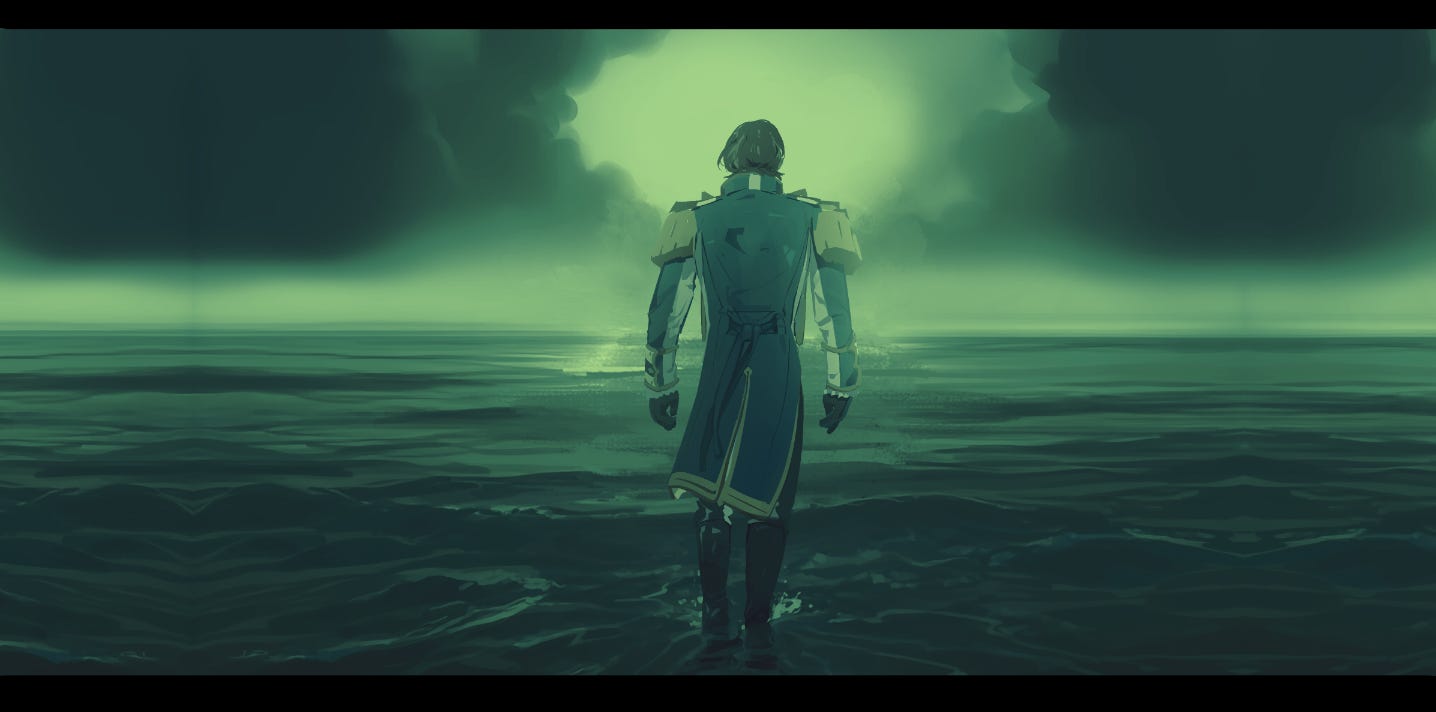
The protagonist of my novel The Reply wants to survive. Wants to maintain command of his ship. Wants recognition from an Admiralty that despises his peculiar gifts. These are his goals. They drive his actions. A lesser version of the character could run on these wants alone and be functional—he’d have clear motivation, generate conflict, pursue objectives.
But Somerset is looking for something else. Something he’d never say aloud because he doesn’t have language for it.
He’s looking to be claimed.
Claiming isn’t like being needed or merely used and employed. Claimed—by something vast enough to see him fully and want him anyway. The sea that hunts him. The officer who mirrors him. The divine attention that might destroy him but would at least know him first.
That’s why the plot can resolve and the character can’t. You can give Somerset everything he wants—command, recognition, survival—and he’d still be looking. The want is achievable. What he’s looking for is a hole in the shape of God.
This distinction is the difference between characters you remember a week after finishing the book and characters who take up permanent residence in your mind. Function versus haunt.
Most contemporary fiction has forgotten the difference.
Characters want things. Clear things. The plot provides obstacles. The climax resolves the wanting. Everyone goes home. The problem is that these characters only exist on the surface—because their creators do too.
You can’t write the looking-for if you’ve never asked yourself what you’re looking for. And that question requires a kind of interiority that’s becoming increasingly rare.
The Flattening
You can’t write what you can’t access in yourself.
This isn’t mysticism. The looking-for—that unnameable need beneath the conscious want—has to come from somewhere. You can’t invent it from nothing. You recognize it. You find it in yourself first, then give it to the character.
Which means the craft failure has a source: writers who’ve never asked themselves the question.
Not out of refusal. It’s not a matter of will not, but cannot.
There’s a term from psychology that I very much like: interoception. The awareness of internal states. Hunger, heartbeat, the texture of your own unease. The capacity to notice what’s happening inside you before you name it, before you explain it, before you translate it into language someone else can understand.
This capacity can be developed. It can also atrophy.
A culture that can't sit still, can't be alone, can't tolerate ten minutes without stimulus, produces people with diminished access to their own interiours. If you've never been quiet enough to notice the difference between what you want and what you're looking for, you can't write characters who carry that distinction. You'll write the surface. Legible wants. Achievable goals. Flat.
I grew up with European parents in America. Spanish, German and Polish. High-context communication, where what matters lives in subtext, in implication, in what remains unsaid. I learned early what it costs when the culture around you can't hear le non-dit. Everything must be stated. Subtext is "unclear." Implication is "poor communication." You're forced to translate yourself into explicit language—and something dies in the translation.
American communication has become pathologically low-context. This isn’t an accent or a dialect but a flattening of the entire register in which complex interiority can be expressed. Characters in American fiction explain their feelings. They announce their motivations. They narrate their growth. They do this because their writers do this—because the culture has forgotten that anything can be communicated without being said aloud.
The result is fiction that functions like a workplace email. Everything important is stated. Nothing is left for the reader to feel into. The text doesn’t trust you, because the writer has forgotten that trust is possible.
This is the disease. The craft failure is a symptom.
Writers who’ve lost access to their own depths produce characters who don’t have depths to access. The looking-for requires interiority. Interiority requires silence. And silence has become so intolerable.
The Marvel Problem
Let me be specific about what flat characterisation looks like at scale.
Marvel villains want things. Clear things. Legible things. Thanos wants to erase half the universe. Killmonger wants to arm oppressed people worldwide. Hela wants to rule Asgard. The goals are stated explicitly, often in monologue. The heroes oppose them. The conflict resolves through combat. Everyone goes home.
This isn’t bad storytelling. It’s functional storytelling. It generates conflict, sustains a plot, delivers spectacle. The machine works.
But ask a different question: what are these villains looking for?
Not what they want. What need would still be unmet if they got everything they’re chasing?
The answer, in most cases, is that the question doesn’t apply. There’s no beneath. Thanos wants the snap. That’s it. He’s not looking for anything underneath the goal—no unnamed wound, no inarticulable absence, no hole shaped like answer. He’s a function dressed as a character. A plot obstacle with aesthetic flair.
The most Marvel can manage is making villains sympathetic. Killmonger has a sad backstory. Thanos believes he’s righteous. The films work hard to make you understand why they want what they want. This is mistaken for depth.
It isn’t. Understanding someone’s motivation isn’t the same as complexity. A character with a legible backstory explaining a legible goal is still flat—just flat with context. Sympathy is not interiority. Explanation is not the looking-for.
Compare Hannibal Lecter.
Hannibal wants things—escape, fine dining, freedom from tedious people. But he’s looking for something else entirely: a mind capable of meeting his. Clarice doesn’t just oppose him or help him. She sees him. That’s why he’s obsessed with her. That’s why the relationship is the engine of everything. You can’t resolve that by catching him. You can’t defeat recognition.
Or consider Daniel Plainview in There Will Be Blood. He wants oil, money, victory over his competitors. He gets all of it. The film ends with him alone in a mansion, having achieved everything he ever chased, and he’s more hollow than when he started. Because what he was looking for—connection he couldn’t admit he needed, a son who’d see him as human, some evidence that his existence mattered beyond accumulation—was never available through the goals he pursued. The want and the looking-for were pointing in opposite directions. That’s why the film is a tragedy and not a success story.
Marvel doesn’t make tragedies. It makes conflict-resolution machines. Efficient, satisfying, forgettable.
The audience gets what it’s trained to expect: problems with solutions. Wants that can be thwarted. Villains who function as obstacles and then stop functioning when the obstacle is removed.
This is what flat characterisation looks like when it has a billion-dollar budget. The spectacle distracts from the absence. But the absence is still there—that hollow space where the looking-for should be. You feel it in how quickly the films evaporate from memory. You saw it, you enjoyed it, you couldn’t tell me what Malekith wanted if your life depended on it.
Characters built only from wants are disposable. The looking-for is what makes them permanent.
You Write What You Can Embody
Here’s the uncomfortable truth: you can only write what you can access in yourself.
Not what you’ve done—what you can feel the shape of. What you can find a path toward, even if you’ve never walked it. The interiority has to exist in you before you can loan it to a character. You can’t fake depth. You can only recognise it.
I write men of violence because I've held violence in my hands. Not theoretically. Not from research. I've made choices in rooms where the wrong word meant consequences I'd have to live inside forever. I've been the calm one when calm was the only thing between a friend and something I can't name here.
My characters are contained because I am contained—and containment is not absence. The people who’ve called me cold, robotic, “Spock” (I’ll take this one as a compliment) , have never seen what I’m holding. They see the stillness and assume the stillness is all there is. They mistake the lid for an empty vessel.
Meanwhile, inside: a furnace. Spiraling. Emotions so strong they’d be illegible if I let them out unfiltered. So I don’t. I learned early that the world isn’t equipped to receive what I actually am. You adapt or you break. I adapted.
My characters know this. Somerset performs control while drowning. Origen processes trauma through millennia of pattern recognition because feeling it directly would annihilate him. Fressange aestheticises war because beauty is the only container that can hold what he's seen. They're not me. But I didn't invent their psychologies. I recognised them. They were already in me, waiting for names.
This is what I mean by access. Not autobiography. Resonance. The ability to feel the shape of an experience from the inside, even if the details differ.
I can write a man who loves his ship like a body because I know what it is to love something that can’t love you back. I can write cosmic horror because the numinous invades my quietest moments uninvited—the vertigo of deep time, the terror of a universe that owes me nothing and will continue without me. I can write the ache of men built for wars that never came because I know what it is to carry capacity that has no outlet. To be made for demands that never arrive.
If you’ve never been quiet enough to hear what you’re actually looking for—beneath the goals, beneath the plans, beneath the story you tell yourself about your own wanting—you can’t write characters who carry that weight. You’ll write wants. Legible, achievable, flat.
The question isn’t whether you’ve suffered enough to write deep characters. Suffering doesn’t automatically produce interiority. Plenty of people suffer and learn nothing about themselves.
The question is whether you’ve sat with yourself. Whether you’ve tolerated the silence long enough to notice the difference between what you say you want and what you’re actually looking for. Whether you’ve felt the shape of your own unnamed needs without rushing to name them, fix them, medicate them, scroll them into oblivion.
Most people would rather do anything than sit in that room.
And so they write characters who’ve never been in that room either. Flat people producing flat people, all the way down.
The Practice
This isn’t mysticism. It’s craft prerequisite. And like any craft prerequisite, it can be practiced.
The exercise is simple. The execution is not.
Sit with a character. Not their plot function. Not their role in the story. Them. Ask what they want. Write it down. Be specific—not “happiness” but the actual thing they’d reach for. Promotion. Revenge. The woman in the blue dress. The ship with their name on the commission.
Then ask: what would still be missing if they got it?
That’s the looking-for. The thing they can’t name. The ache that won’t resolve even if every conscious goal is achieved.
Somerset gets command. Gets recognition. Gets everything he says he wants. And he'd still be looking. Because what he's looking for is being claimed by something that sees him—and institutional success can't provide that. Only the sea can. Only Daud can. The want is achievable. The looking-for requires something that can't be pursued, only encountered.
If you do this exercise and come up empty—if the character only has wants, no looking-for—you’ve diagnosed the problem. The character is flat. Not because you made a craft error, but because you reached into yourself for the deeper layer and found nothing to draw from.
Which means the practice isn’t really about characters. It’s about you.
When did you last sit in silence long enough to notice what you’re looking for? Not what you want—what you’re looking for. The need beneath the goal. The ache that wouldn’t resolve even if you got everything you’re chasing.
If you can’t answer, your characters can’t either.
The practice is simple: stop. Be quiet. Be alone. Notice what arises when there’s nothing to react to, nothing to consume, nothing to distract. The discomfort that emerges isn’t the enemy. It’s the material.
Most writers would rather read another craft book. Watch another video essay. Collect another technique. Anything but sit in the room with themselves and notice what’s actually there.
I’m not telling you to suffer. I’m not telling you to excavate trauma. I’m telling you to pay attention. To develop the capacity to feel the texture of your own wanting without immediately naming it, fixing it, optimising it into a goal.
The looking-for lives in the space before language. You have to be willing to stay there long enough to feel its shape.
That’s the practice. There’s no shortcut.
The Death of Nuance Is a Choice
So. Flat characters come from flat people.
Not stupid or untalented people, mind. People who’ve lost access to their own depths—or never developed it—because the culture they swim in doesn’t require it and at worst actively discourages it.
You can get by without interiority. You can publish, produce, profit. The market doesn’t demand complexity. It barely tolerates it! Audiences trained on conflict-resolution machines will accept conflict-resolution machines. The feedback loop closes. Everyone gets what they expect. Nothing haunts anyone.
But the work that lasts—the characters that take up permanent residence in the mind—comes from writers who’ve done the harder thing. Who’ve sat in silence. Who’ve asked themselves what they’re looking for and stayed with the discomfort of not knowing.
I write men who were made for worlds that demanded everything because I understand the particular grief of being made for demands that never come. The soul built for storm, landlocked. The capacity for valor with no war to spend it on.The modern world didn't eliminate the capacity. It eliminated the demand. And capacity without demand becomes a kind of rot.
I languish in a demi-solde of modernity—half-pay, half-life, waiting for orders that won’t arrive from institutions that no longer remember what they’re for. I suspect I'm not the only one. The reenactors know. The wargamers know. Anyone who's ever felt overbuilt for the life they're living knows.
That’s not a complaint (although permit me some.) It’s material. For art. Because aren’t we creatives just the best at turning suffering into beauty?
The ache of wanting to be tested and never being tested. The grief of carrying capacity that rusts from disuse. The looking-for that can’t be satisfied by comfort, safety, the padded corners of a world designed to demand nothing of anyone.
Most writers have never examined this in themselves because it’s not comfortable. It doesn’t fit the therapeutic model where all desires are processed toward resolution. Some desires don’t resolve. Some needs can’t be met by the world as it is. Sitting with that—without numbing it, naming it into submission, or scrolling it into background noise—is the work.
If you’ve never felt the shape of that, you can’t write characters who carry it. You’ll write people who want things. Achievable things. Legible things. Things that can be obtained and then the story ends.
You won’t write the ache.
The best fiction isn’t written by people who’ve suffered most. It’s written by people who’ve stayed in the room with whatever they carry. Who’ve refused the easy exit. Who’ve let the silence get loud enough to hear what’s underneath.
The death of nuance isn’t inevitable. It’s a choice—made daily, by writers who won’t sit still, by audiences who won’t tolerate ambiguity, by a culture that’s forgotten that some things can only be communicated in silence.
You can choose differently.
But you have to be willing to stay in the room.
I write because there’s nowhere else for what I am to go. The capacity built for storms, spent on sentences. The valor that would have been spent on battlefields, transmuted into characters who get to live in worlds that still demand everything.
It’s not enough. It’s never enough.
But it’s the only legitimate outlet I’ve found.
For more craft essays and psychological character design navel-gazing, subscribe for posts every Tuesday.
Fair winds,
D. S. B.